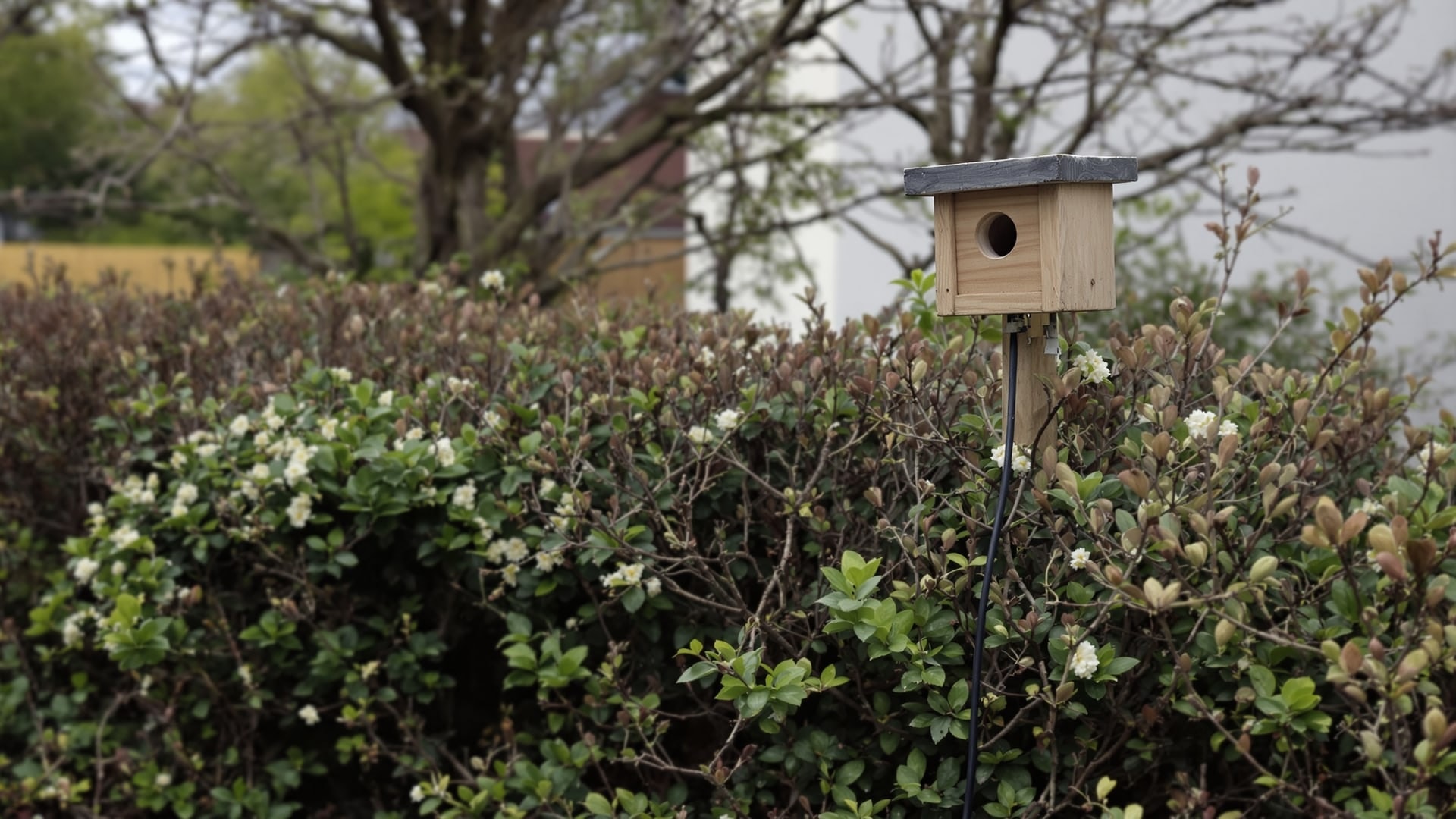
Wired or wireless camera?
This was Handykam’s most-read and most-linked article. It answers the question everybody asks first, and it answers it in the direction nobody expects: most people who start out wanting a wireless nest box camera end up with a wired one. The reasoning has not aged, because it is about physics and houses rather than about any particular product.
What each one actually means
A wireless nest box camera has a built-in transmitter that sends pictures and sound to a receiver indoors. The receiver plugs into a television, a video recorder, or — with the right card — a computer.
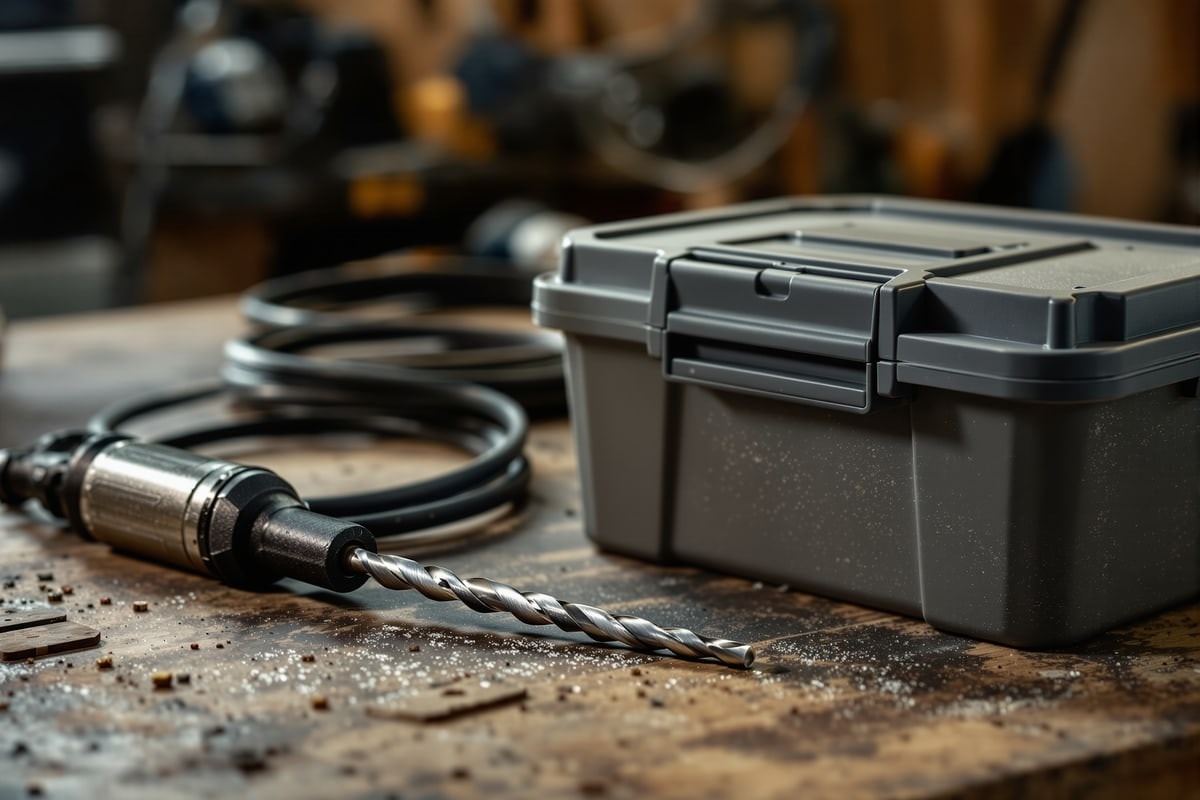
A wired nest box camera has a cable that runs back to the house or classroom from the box. The cable carries the sound and pictures, and plugs into the same places. At some point it has to get through a wall or an open window. Because there are already plugs fitted to most camera cables, that means drilling a substantial hole — typically 16mm, or three-quarters of an inch — right through the wall, which in turn means a 16mm tungsten carbide bit around 400mm long.
That drill bit is the thing that puts people off. It should not. It presents no difficulty to anyone who has drilled a wall before, and the job takes a couple of minutes — provided, obviously, you do not hit a pipe or a cable on the way through. Check before you drill.
The catch: everything needs power
At first glance wireless looks better. No unsightly cable draped through the garden, no hole through the wall. If only it were that simple.
The problem is that the camera in the nest box — plus any lights or infra-red illuminators, plus the transmitter itself — has to be supplied with power, typically 9v to 12v DC. That power has to come from somewhere. You can use a mains adapter, or you can use batteries.
Batteries sound like the answer and are not. Small batteries last a few hours. Even substantial rechargeable batteries typically last less than a day. And you cannot nip out to the nest box to swap a battery whenever you fancy watching — that level of disturbance simply frightens the birds off, quite apart from being unlawful during the breeding season. So you need a few metres of wire from the battery to the box to give the birds their privacy, and now you have a new problem: where does the battery live? It has to be in a weatherproof container, or indoors.
If it lives indoors, where it can be run from a mains adapter, you are back to drilling through a wall — admittedly a smaller hole. At which point, why not run a wired system in the first place?
And then you need a switch
Suppose you go with a weatherproof box outside — a small plastic toolbox or a clip-lid storage box, both of which work fine. You still have a dilemma. How do you turn it on when you want to watch? You cannot leave it running; it will flatten the battery in a few hours. So now you need a switch, preferably a weatherproof one, on the battery box, and you have to walk out to the garden and flick it every time you want to see what is happening in the box.
So you run a wire anyway
It is easy enough to run a 9v or 12v wire from inside the house out to the nest box, so that the camera and transmitter are powered from a mains adapter. It can stay on permanently or be switched from indoors. But since you are running a wire out to the box regardless — why not run a single wire that carries the power out and brings the pictures back?
That is why most people end up wired. Not because wireless does not work, but because the power requirement reintroduces the cable you were trying to avoid, and then adds a transmitter, a receiver, a battery and a switch on top of it.
The case where wireless genuinely wins
There is one clear scenario. If power is already available where the camera is going, wireless is easier and better. The obvious example is a nest box on the wall of a garden shed that has power laid on inside it: drill a small hole through the shed wall, plug in the camera and transmitter, leave them running, and the signal comes back to the receiver by your television. No hole in the house at all.
The same logic applies to outbuildings, garages, stables and any part of a garden with an outdoor socket. The general rule is that wireless removes a signal cable, never a power cable — so it is worth having exactly when the power problem is already solved.
1.2GHz, 2.4GHz and 5.8GHz
Most wireless systems transmit on one of three bands, and the differences matter.
- 1.2GHz systems are noticeably cheaper, for a good reason: in the UK it is technically illegal to use the 1.2GHz band for private use. It is not illegal to sell or own such a system — only to transmit on it. The realistic likelihood of enforcement against a garden nest box is negligible, but a great many 1.2GHz systems in nest boxes and baby monitors are, strictly, breaking the law.
- 2.4GHz is the band reserved for exactly this sort of low-power use in the UK, and is legal to use. Everyone and their uncle is on it — baby monitors, wireless security cameras, WIFI, and an encyclopaedia's worth of other gadgets. In practice most systems coexist because they are all low-powered and do not transmit far, but a degree of interference is normal and shows up as pictures breaking up.
- 5.8GHz is a clean band with more room, but it does not travel as far. Range is the trade-off.
Analogue or digital wireless
Within 2.4GHz there are two quite different technologies. Analogue systems sit on a fixed frequency. Digital systems encode the signal and hop automatically between frequencies, which makes the link considerably more robust and can push the usable range past 200 metres in good conditions. If you are going wireless, digital is worth the difference; a fixed-frequency analogue link in a street full of WIFI is where most disappointing wireless installations come from.
In summary
Wireless nest box systems work well in specific circumstances — chiefly when there is already power where the camera is going. But a lot of people who start with wireless eventually come back to wired, because wired systems, though a bit of a job to install, then give years of simple, cheap, trouble-free service. The cable is a one-afternoon problem. The battery is a permanent one.
Whichever route you take, put the box up outside the breeding season and then leave it alone. Nesting birds are protected under the Wildlife and Countryside Act 1981, and Natural England's guidance covers when a licence is required. The BTO and the RSPB both publish current siting advice.
Related pages: FAQ: cables · How an analogue camera works · FAQ: WIFI IP camera · Troubleshooting wireless camera issues