FAQ — Cables
Cables are the least glamorous part of a camera system and the source of most of its faults. Handykam supplied three families — AV for analogue cameras, DC for power, and network cable for IP cameras — and these were the questions it was asked about them.
Analogue AV cables
What connectors are on the cables?
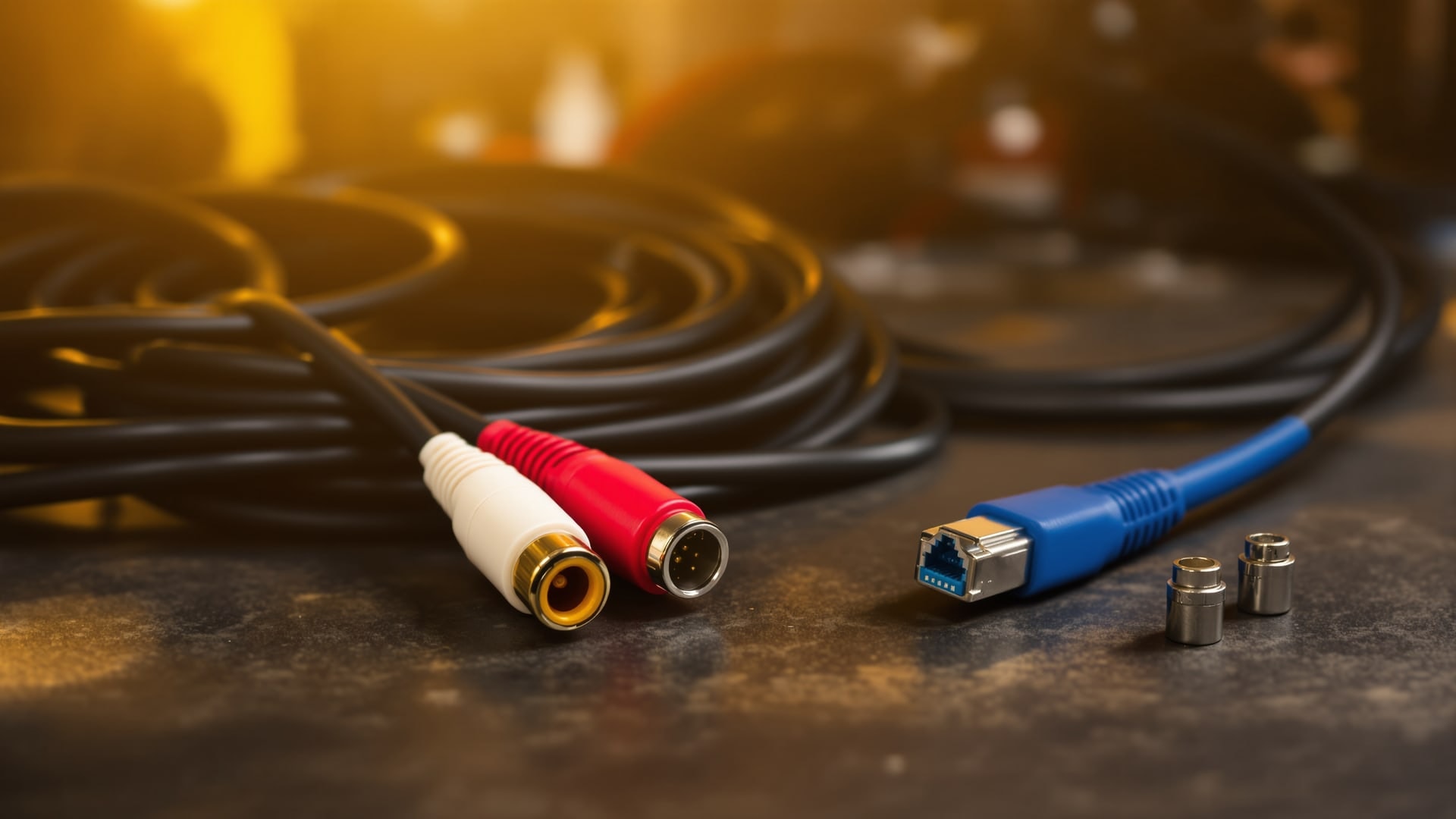
Three connectors at each end: yellow for video, white for audio, and red carrying 12v power out to the camera. The wiring convention and how it all plugs together is set out in How an analogue camera works.
Can you link two cables together?
Yes, with an extension kit. It sounds daunting and is not. The power connector (red) plugs into the female connector of the other cable directly. The yellow and white connectors need a coupler — the small double-ended connector in the extension kit that looks like a miniature pair of binoculars.
Can I link more than two?
Yes, as many as you like in principle. Be aware that there is a slight reduction in picture quality with every extension, and it compounds. If you know in advance that you need fifty metres, a single fifty-metre cable will always outperform five ten-metre cables joined together.
Can I repair a damaged cable?
We would not advise it. The power core of the cable is screened — it has a metal sleeve around it to stop it interfering with the other cores — and the cable has a common negative earth which, if reconnected incorrectly, can affect the camera. Beyond that it is genuinely fiddly work for a poor result. Replacing the cable is easier, cheaper and more reliable.
Why does my picture have bars or grain on a long run?
Two usual causes. Either signal loss over a long or joined run, or interference picked up from mains wiring the cable runs alongside. Where a camera cable has to cross mains cable, cross it at right angles rather than running parallel with it.
DC cables
What is DC?
Direct current — the constant one-way flow of electrons used by batteries, solar panels and mains adapters. Cameras of this type run on 12v DC.
What size are the connectors?
Most of the cameras in this range used a barrel connector of 2.1mm inner and 5.5mm outer diameter. Other cameras vary, and a 2.5mm inner barrel in a 2.1mm socket is a common and frustrating mismatch — check before buying a replacement adapter.
How does a DC cable differ from AV and network cable?
A DC cable carries power only, normally at around 12v. It is what you use for a wireless or network camera that needs feeding but sends its pictures another way. An AV cable carries power and video and audio. A network cable carries data, and power too where Power over Ethernet is used.
Does length matter for power?
Yes. Voltage drops along a long thin DC run, and a camera that browns out at fifty metres will work perfectly at ten. If a camera behaves oddly at the end of a long DC cable — resetting, poor night vision, no infra-red — suspect the power before the camera.
Cat5, Cat6 and LAN cables
What is Cat5 cable?
Category 5 cable, used extensively for Ethernet connections in local networks. It is the standard eight-core twisted-pair cable with the clip connector on each end.
What is the difference between Cat5, Cat5e and Cat6?
The higher the category, the better the supported speed and the lower the losses over distance. For a single camera at domestic distances any of them is fine; Cat6 is worth having where the run is long, where several cameras share the route, or where the cable is going somewhere it will not easily be replaced.
Can a network cable power the camera too?
If both the camera and the switch support Power over Ethernet, yes — one cable does both jobs. This is the neatest way to install a network camera at a distance and removes the need for a separate DC run.
How long can a network run be?
Ethernet over copper is generally reliable to about 100 metres per run. Beyond that you need a switch part-way, or fibre.
Cable, boxes and birds
Whatever the cable, keep the slack out of the box interior. Handykam's boxes were supplied with trunking, connector trays and false ceilings for exactly this reason: loose cable inside a nest box gets built into nesting material, chewed, or used as a perch. Dress the cable, secure it, and leave nothing loose where a bird can reach it.
Related pages: How an analogue camera works · Wired or wireless camera? · FAQ: wired small analogue camera · model index