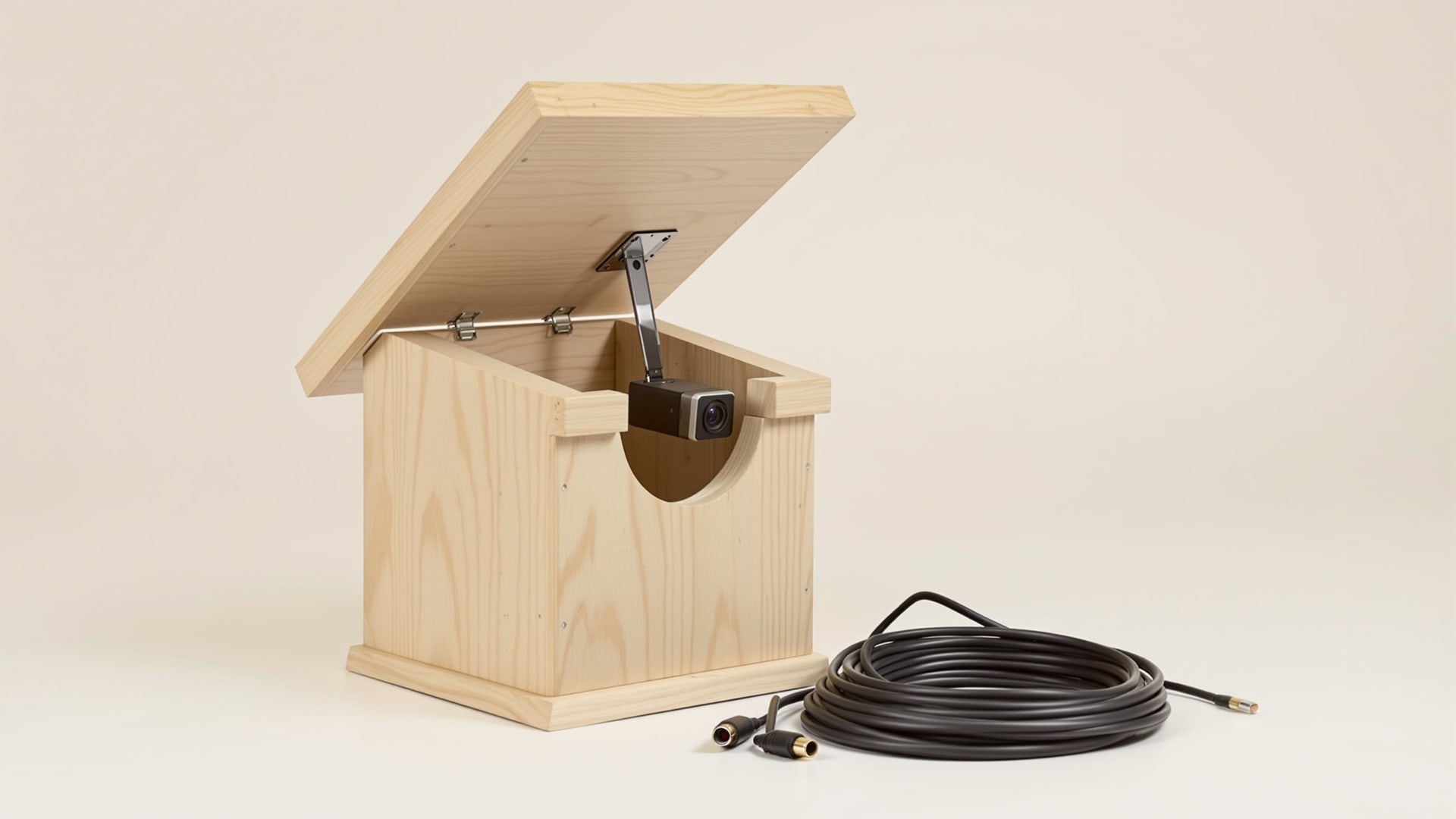
Wired camera nest box system — 20m cable (HK100460w)
Handykam ceased trading. Nothing here is for sale, and no orders, enquiries or support can be handled.
If the 5MP WIFI kit was the company's last word, this was its long sentence. The wired pine nest box system was the staple product for most of Handykam's trading life: a hand-built box, a small high-resolution analogue camera already mounted inside it, twenty metres of cable, a power supply, and a picture on the television. It became Handykam's staple model, supported by most of the company's advice pages.
What it was
A complete plug-in-and-play system. A pine bird box, camera-ready and pre-drilled; a colour camera with infra-red night vision and a sensitive microphone; a single 20-metre AV cable carrying 12v power out to the camera and video and audio back; a 12v power supply; and a SCART adapter for the televisions of the era. You connected the cable to the AV inputs on a television, pressed the AV button, and watched.
The appeal was that nothing had to be configured. There was no network, no app, no password, no pairing. If the picture was wrong, there were only three things it could be — power, cable or focus — which is exactly why the same system kept being specified for schools and nurseries long after fancier options existed. The low-voltage design was reassuringly boring.
Technical specification
| Item | High resolution colour camera |
|---|---|
| Image device | 1/3-inch Sony CCD sensor |
| Horizontal resolution | 700 TVL |
| Pixels (PAL) | 976 (H) × 582 (V), approx. 570K |
| TV system | PAL, 976-line scanning |
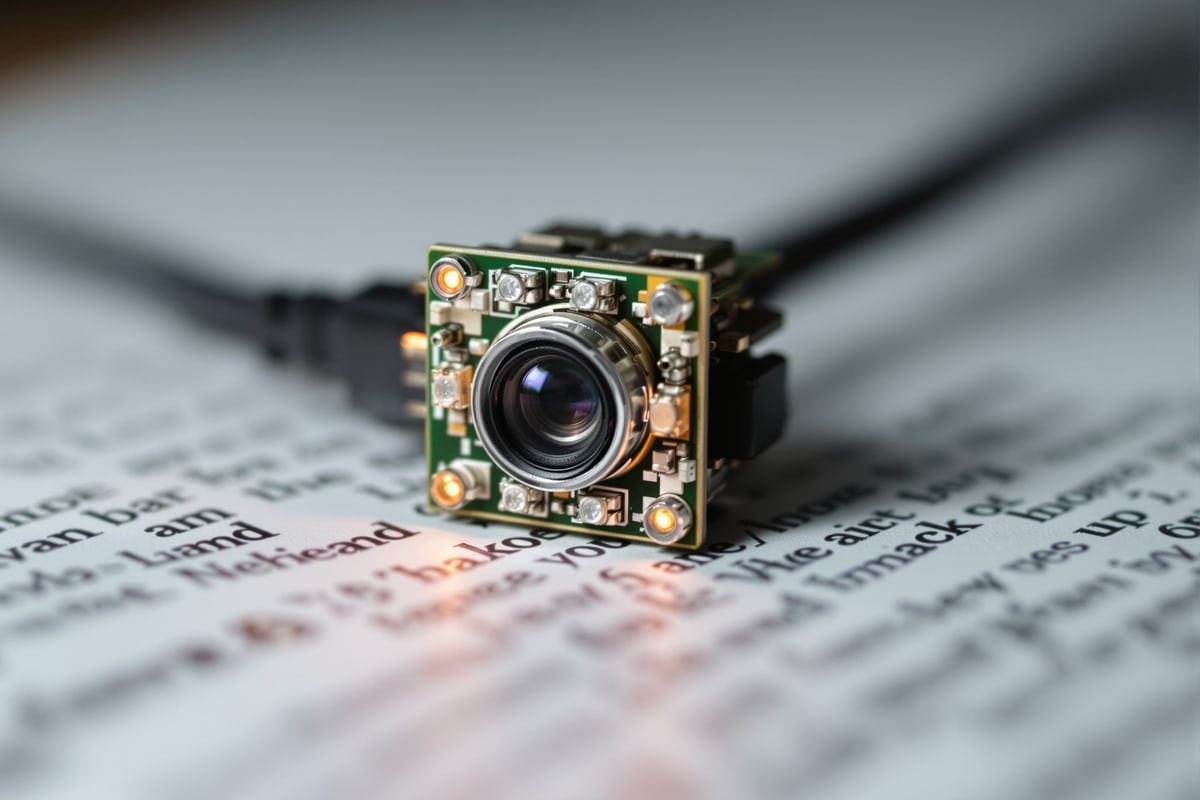
| Lens | All-glass 3.6mm, 3 megapixel rated |
| Infra-red | 10 × 5mm IR LEDs, auto-switching, approx. 8m range |
| Minimum illumination | 0 lux with LEDs on (F1.2) |
| Signal-to-noise ratio | ≥48dB (AGC off) |
| Audio | High-sensitivity microphone |
| Video output | 1.0Vp-p, 75Ω |
| Electronic shutter | Auto, PAL 1/60 – 1/100,000 sec |
| White balance | Auto |
| Power | 12v DC ±10%, 500mA |
| Weight (camera) | 65g |
| Operating temperature | −10°C to +50°C, 95% RH max |
The 700 TVL figure is a television-lines measurement rather than a megapixel one; the conversion between the two conventions, and why a "high resolution" analogue camera and a low-megapixel digital one are not directly comparable, is set out on Camera resolution.
What was in the kit
- 1 × hand-built pine camera bird box
- 1 × CCD camera with integrated plugs
- 1 × swivel and tilt bracket, with bolt, wing nut and lens cap
- 1 × 20m AV cable (30m, 50m, 75m and 100m runs were available)
- 1 × 12v power supply
- 1 × SCART to AV converter
- 1 × printed connection instructions

Fitting the camera
Mounting was as simple as the electronics. A 5mm hole was made in the box ceiling, the bolt pushed through, and the wing nut spun on from above; the camera could then be tilted and the 3.6mm lens focused by hand. Because the lens was wide, getting the whole floor of the box in frame was easy — the usual mistake was mounting too low and filling half the picture with the front wall.
Cable management was the other half of the job. The box was supplied camera-ready, meaning the cable route was already drilled and trunked and the slack could be dressed away behind a false ceiling or wound around a connector tray, out of reach of nesting material and inquisitive birds. Everything on how to get the cable from the box to the house — the hole size, the drill bit, and why the wire is unavoidable even on a "wireless" system — is in Wired or wireless camera?.
What it suited
The box was designed around hole-nesting garden birds — blue tits, coal tits, great tits, marsh tits and house sparrows — with interchangeable hole sizers to restrict the entrance to the species you wanted. In practice the same camera and cable ended up in a great many other places: bird tables and feeding stations, hedgehog boxes, bat boxes, dormouse boxes, aviaries, hen houses and pet enclosures. It was the camera, not the box, that people kept.
Choosing the hole size is the one decision that genuinely changes who moves in. The BTO's nest box guidance and RSPB species pages give the current recommended dimensions; a 25–28mm hole favours blue and coal tits, 32mm suits great tits and house sparrows.
Compatibility and conversion
The system was analogue throughout and compatible with other analogue equipment — recorders, splitters, switchers and transmitters. Handykam marked analogue-compatible items with a blue circle so that customers mixing kit from different years could tell at a glance what would work together. An analogue camera could be:
- Made wireless by adding a separate transmitter and receiver pair, at the cost of everything described in the wired-or-wireless article.
- Connected to a computer through a USB capture device.
- Put on a network through an IP converter, which digitised the analogue signal and presented it to the router, making it viewable on phones, tablets and computers.
- Recorded continuously on a digital video recorder — see the DVR and NVR FAQ.
Related pages: FAQ: wired small analogue camera · How an analogue camera works · FAQ: cables · model index