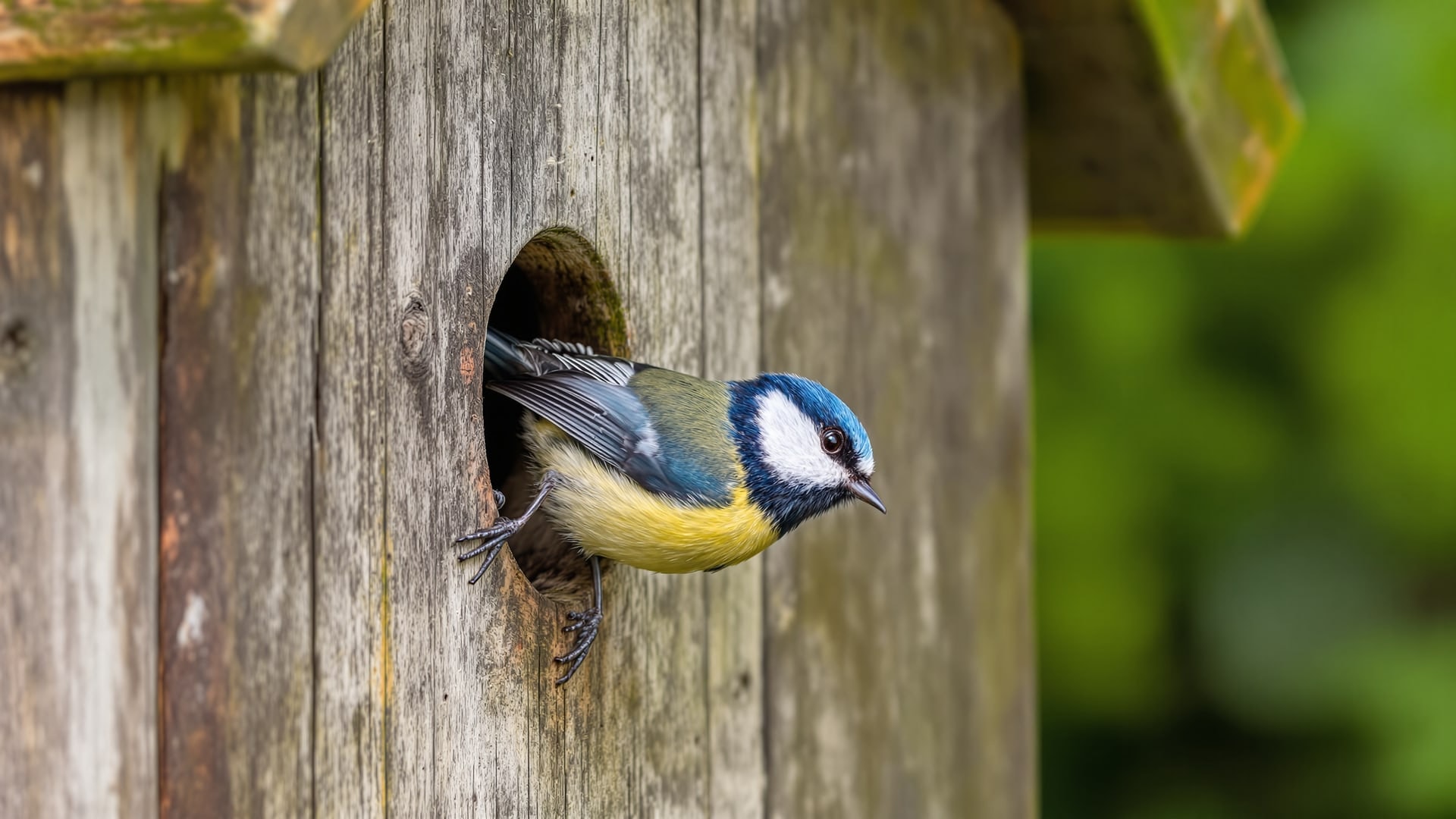
Wildlife camera technology definitions and glossary
There is a great deal of jargon in wildlife camera technology and it can be overwhelming. This is the A–Z Handykam kept to cut through it — the terms that come up when you are putting a camera into a nest box, an owl box or a hedge, covering both the woodwork and the electronics. Its companion, covering video, recording and network terminology, is the CCTV and camera technology glossary.
A
- Aerial booster
- A device fitted to a wireless camera system that strengthens the signal reaching the receiver. Useful where a transmitter is at the far end of a garden or behind a stone wall; no substitute for choosing the right frequency band in the first place.
- AV
- Audio-visual: sound and picture together. Most Handykam wildlife cameras used AV connectors, carrying both on one cable.
B
- Bracket, swivel and tilt
- The small adjustable mount that fixes a camera inside a box and lets it be angled and locked with a finger nut. The single most useful accessory in the range, because a fixed camera points wherever the box lets it.
- Brood
- To sit on eggs, and by extension the clutch of young themselves. "The female broods the eggs." Nest box cameras exist largely to watch this.
C
- Camera ready
- A box supplied already modified to take a camera: a mounting point, a drilled cable route and trunking to conceal and protect it. It means a camera can be added later without bringing the box down and drilling it in situ — which matters enormously for anything mounted high in a tree.
- Cedar
- Western red cedar. A durable, aromatic timber, naturally rot-resistant and light for its strength, which is what makes it good for small mammal and dormouse boxes.
- Connector tray
- A piece of wood projecting inside or behind a box that lets cable be wound and tidied away, keeping slack out of reach of nesting birds.
D
- Day-night camera
- A camera that produces colour images in daylight and switches automatically to infra-red black-and-white in the dark. Every camera in this range worked this way.
- Drill bit
- The working, interchangeable end of a drill. Nest box camera installations traditionally called for a 16mm tungsten carbide masonry bit around 400mm long, to get a cable through a house wall — which sounds alarming and takes about two minutes. Check for pipes and cables first.
F
- False ceiling
- A second panel inside the box roof, creating a void where cables and connectors can live out of the birds' way while the camera looks down through it.
- Feeder
- A bird feeder or feeding station. Camera feeders let you watch birds feeding rather than nesting, and work all year rather than for one season.
- Field of view
- How much the camera can see, expressed as an angle. Inside a box it determines whether you see the whole nest cup or a close-up of one corner; it is set by the lens, not the sensor.
G
- GHz
- Gigahertz — a billion cycles per second. Wireless camera systems are described by the frequency band they transmit on: 1.2GHz, 2.4GHz or 5.8GHz. The differences, including which are legal to use in the UK, are covered in Wired or wireless camera?.
H
- Hole protector
- A metal plate fitted around a nest box entrance to stop the hole being enlarged by a predator or a woodpecker.
- Hole sizer
- An interchangeable plate that sets the entrance diameter and so influences which species can use the box — roughly 25–28mm for blue and coal tits, 32mm for great tits and house sparrows. Current recommended sizes are published by the BTO.
I
- IR — infra-red
- Light just beyond the red end of the visible spectrum. Invisible to us and to the birds, which is why cameras use it to illuminate a nest box at night rather than a white light.
- IR cut filter
- A physical filter that blocks infra-red during the day, so daylight colours look rich and accurate, and mechanically moves aside at night so the camera can see by its own infra-red illumination. The faint click at dusk and the brief reddish cast before switching are this filter moving.
L
- Lux
- A measure of illumination. Nest box cameras typically switch to infra-red at around 1 lux, and quote "0 lux" performance meaning they can see in total darkness using their own LEDs.
M
- Motion capture
- Recording only when something moves. On a nest box camera this is the difference between reviewing four minutes of footage and four hours, and it is the single setting that makes long-term monitoring practical.
N
- Nest box / bird box
- An artificial cavity provided for hole-nesting birds. Design, siting, aspect and hole size all affect occupation far more than anything about the camera inside it.
O
- Owlet safety tray
- A landing platform outside the entrance of an owl box. Owlets clamber out well before they can fly properly; the tray, plus a rough-barked tree they can climb, is what lets an early excursion end well. See the Barn Owl Trust's nestbox guidance.
P
- PIR — passive infra-red
- The motion sensor in a trail camera. It does not emit anything; it watches for a moving heat source crossing its view against a cooler background. This is why trail cameras trigger less reliably on hot days and why sunlit vegetation sets them off.
- Plywood
- Timber made from thin veneers stacked with their grain at alternating angles and bonded under heat and pressure. Very strong and stable for its weight, which is why the large outdoor owl boxes used pressure-treated FSC-certified 12mm ply rather than solid timber.
- Predator guard
- A fitting that prevents cats, squirrels, woodpeckers or corvids reaching into a box, usually by extending the depth of the entrance tunnel or armouring the hole.
- Power supply
- A mains adapter producing the low-voltage DC — usually 12v — that a camera runs on. Voltage, current and connector polarity all have to match; the wrong adapter is the commonest way to damage a camera.
- Pulley
- A Handykam term for the rod used to draw a camera cable through a wall after the hole is drilled.
R
- Roost
- Where a bird sleeps, and the act of doing so. Nest boxes are used for roosting outside the breeding season as well as for nesting in it, so a camera is worth leaving on through the winter.
S
- Semi-wireless
- An arrangement where a DC cable supplies power to a camera continuously, so it can transmit its picture wirelessly without depending on batteries. In practice this is what most "wireless" garden installations end up being.
- Shielded cable
- Cable with a metal screen around a core to prevent interference and signal loss. In a camera AV cable the power core is screened so it does not corrupt the video travelling the other way.
T
- Trail camera / camera trap
- A weatherproof, battery-powered camera that records automatically when its PIR sensor detects movement. See How trail cameras work.
- Tree protector
- A pad or sleeve used where a box is wired or strapped to a tree, so the fixing does not cut into the bark as the trunk grows. Fixings need slackening periodically regardless.
- TVL
- Television Lines, or Lines of Horizontal Resolution — the international standard for measuring an analogue camera's resolving power. More lines means a sharper image. Converting between TVL and megapixels is covered on Camera resolution.
W
- Window
- A perspex panel fitted to a nest box so the interior can be seen directly. Useful for inspection out of season; not a substitute for a camera, because opening or exposing an occupied box is disturbance.
- Wired
- A camera setup using a cable to carry audio and video, and usually power in the other direction along the same run.
- Wireless
- A radio-based system transmitting the picture without a signal cable. It still needs power, which is the catch.
Related pages: CCTV and camera technology glossary · Wired or wireless camera? · Camera resolution