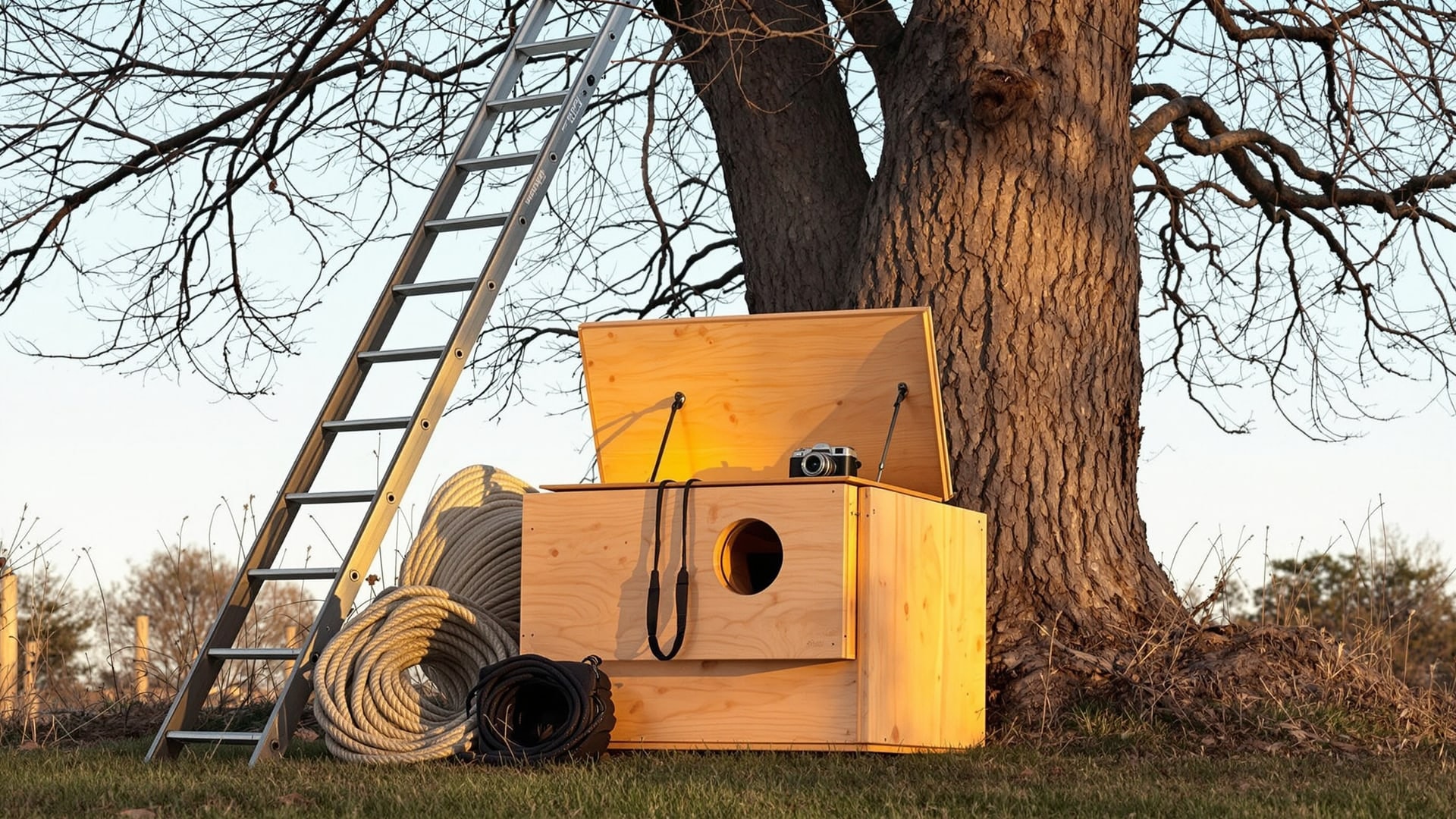
Steps to fitting an owl box camera
Every year Handykam supplied many hundreds of camera systems that let people watch and monitor owls, around the home and in remote locations. Fitting one is not difficult, but the order in which you do things matters enormously — and the first several steps have nothing to do with the camera at all.
Before you touch the box
1. Watch the box for a while first
Observe it over a period, from a distance, to establish whether it is in use. This is not optional politeness; it is the difference between a routine job and an offence. Owls are quiet and a box in use can look empty from the ground.
2. Talk to a wildlife organisation
Speak to one or two — your local Wildlife Trust, or the Barn Owl Trust for barn owls specifically. They will advise on maintaining the box, on recording observations that contribute to national statistics through the BTO Nest Record Scheme, and — most importantly — on when it is permissible to approach a box. In many cases they can do the work for you, which is often the better answer.
3. Understand the legal position
Disturbing owls at a nest is illegal and requires a licence. Barn owls are on Schedule 1 of the Wildlife and Countryside Act 1981, which makes it an offence to disturb them intentionally or recklessly at or near an active nest — and fitting a camera into an occupied box is exactly that. Natural England's guidance sets out the licensing position. Be careful and follow official guidance; if you are not sure, ask rather than assume.
4. Choose the right time
When there is no activity in or around the box — confirmed with the relevant charity — it may be a good time to inspect. That is also when to do any repairs. Approach carefully: there may still be owls inside.
Fitting the camera
5. Work on the ground wherever possible
Fitting a camera is far easier with the box on a bench or on the grass than at the top of a ladder. You can move the camera around freely, see what you are doing, and you are not holding a screwdriver one-handed at height. If the box is already mounted and cannot come down, plan the whole job before you go up: take everything you need, and take it in a bag rather than in a pocket.
6. Find the best camera position, and test it
Test the camera properly before committing to a position. Check the field of view covers the floor area where a nest will actually be, remember that a nest builds upwards over the season, and make sure nothing in the box — a hatch edge, a bracket, the cable — is standing in the frame. Focus at the working distance rather than at infinity; the technique of focusing over newsprint at a measured distance is set out in the WIFI IP camera FAQ.
7. Plan the mounting and the cable route
Most systems are straightforward. Decide where the camera bracket fixes, and modify the box for the cable: a drilled route, trunking, and somewhere to dress the slack out of the birds' reach. A box supplied camera-ready already has this, which is why it is worth specifying even if the camera comes later.
8. Install calmly and do a good job
Keep calm, work steadily and do it properly. This is a job you do not want to repeat, because repeating it means disturbing the box again. Weatherproof every connector, secure the cable so wind cannot work it loose, and make sure nothing can chafe.
9. Plug in, configure, and then leave it alone
Connect, set up the recording or viewing, check the picture, and then stay away. The whole point of a camera is that it removes the need to go anywhere near the box again.
Practicalities for a tree-mounted box
An outdoor owl box weighs around fifteen kilos. Installation is a two-person job with ladders and ropes, and the box is hauled up on ropes through its mounting hooks rather than carried. Anything that can be done on the ground should be. Check straps and fixings periodically as the tree grows, and use a tree protector where a fixing bears on bark.
Which camera
Cable runs to owl boxes are long, which historically favoured the wired analogue systems with 30 or 50 metres of cable. Network cameras changed that where there is any power or network reach — and Power over Ethernet in particular means a single cable can do everything, which for a box at the far end of a field is a considerable simplification. The trade-offs are in Wired or wireless camera?.
Related pages: Outdoor owl box (HK100007) · How to build a barn owl box · Conservation