Education — universities, colleges, schools and nurseries
Handykam ceased trading. Handykam supplied this sector. No equipment, discount or support can be supplied.
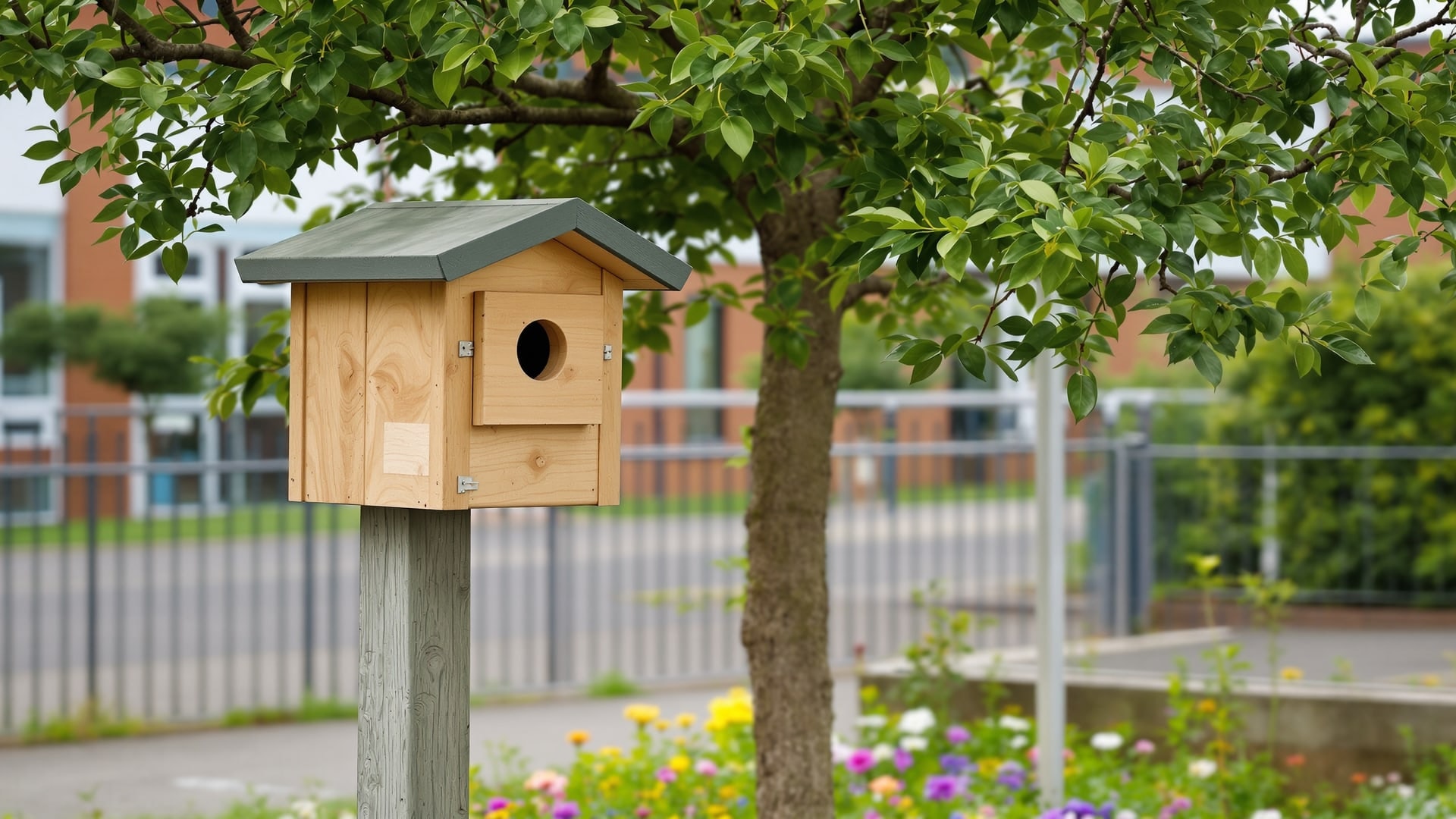
Education was one of the sectors Handykam supplied most consistently. Over the years its cameras went into hundreds of schools and dozens of universities, from nursery settings watching a bird box on a screen in the corner of a room to university departments running long-term monitoring. The company offered discounts to education deliberately, on the stated grounds that it wanted to help produce the next generation of ecologists and scientists.
Why it worked in a classroom
A nest box camera does something very few teaching resources manage: it puts real, unpredictable, live animals on a screen in a room, every day, for a whole season. Nothing is staged. The eggs may or may not hatch. Some chicks fledge and some do not. Children get a continuous, genuine natural history story attached to a box they can see through the window, rather than a video of somewhere else.
It also connects the indoors to the outdoors, which is the point of the wider push towards outdoor learning and rewilding of school grounds. A camera is a reason to have a nest box, a nest box is a reason to think about the grounds, and the grounds become a subject rather than a space.
The practical reasons schools chose this kit
- Low voltage. The whole system runs on 12v DC, which is reassuringly safe in a nursery, school or college setting and simplifies a great many conversations.
- Nothing to configure. The wired analogue systems plug into a television and work. There is no network, no password, no app and no IT department involved — a considerable advantage in a school, where those things become obstacles.
- Nothing to break. One camera, one cable, one adapter. If it stops, it is the adapter or the cable.
- It survives the holidays. The system does not care that nobody is in the building for six weeks, which is exactly when the interesting things happen.
- Instructions written for people, not engineers. The company's whole approach to documentation was built around this.
Where a school did want the picture on a network — displayed in a hall, on a website, or accessible from home — the later network cameras did that, and older analogue installations could be brought onto a network with an IP converter rather than replaced.
Curriculum fit
The obvious home is science: life cycles, habitats, adaptation, food chains, and the difference between observation and inference. But the same camera served design and technology (building and siting the box), mathematics (counting, timing, recording, plotting), literacy (observation diaries), computing (networking a camera, editing footage), and art. The recording side, where a class keeps a log across a whole season, is where it stops being a novelty and becomes a piece of real work.
Doing it properly
Two things are worth getting right. First, put boxes up outside the breeding season and then leave them alone — nesting birds are protected under the Wildlife and Countryside Act 1981, and a camera exists precisely so that nobody has to go and look. Second, be honest with children about outcomes. Nests fail. Predation happens. Broods starve in a cold spring. Handling that truthfully is part of the value of watching something real rather than something edited.
Where to get the natural history right
The equipment is the easy part; the ecology is where a school should be reading. The BTO's nest box guidance covers siting and hole sizes, and BirdFacts is a solid species reference. The RSPB's activities pages are written for exactly this audience, and the Big Garden Birdwatch in January is a straightforward whole-class activity. Your local Wildlife Trust will often work directly with schools, and the Wildlife Trusts' actions pages are full of things a class can do to make the grounds worth filming.
Related pages: Science and research · Conservation · Springwatch cameras