How trail cameras work
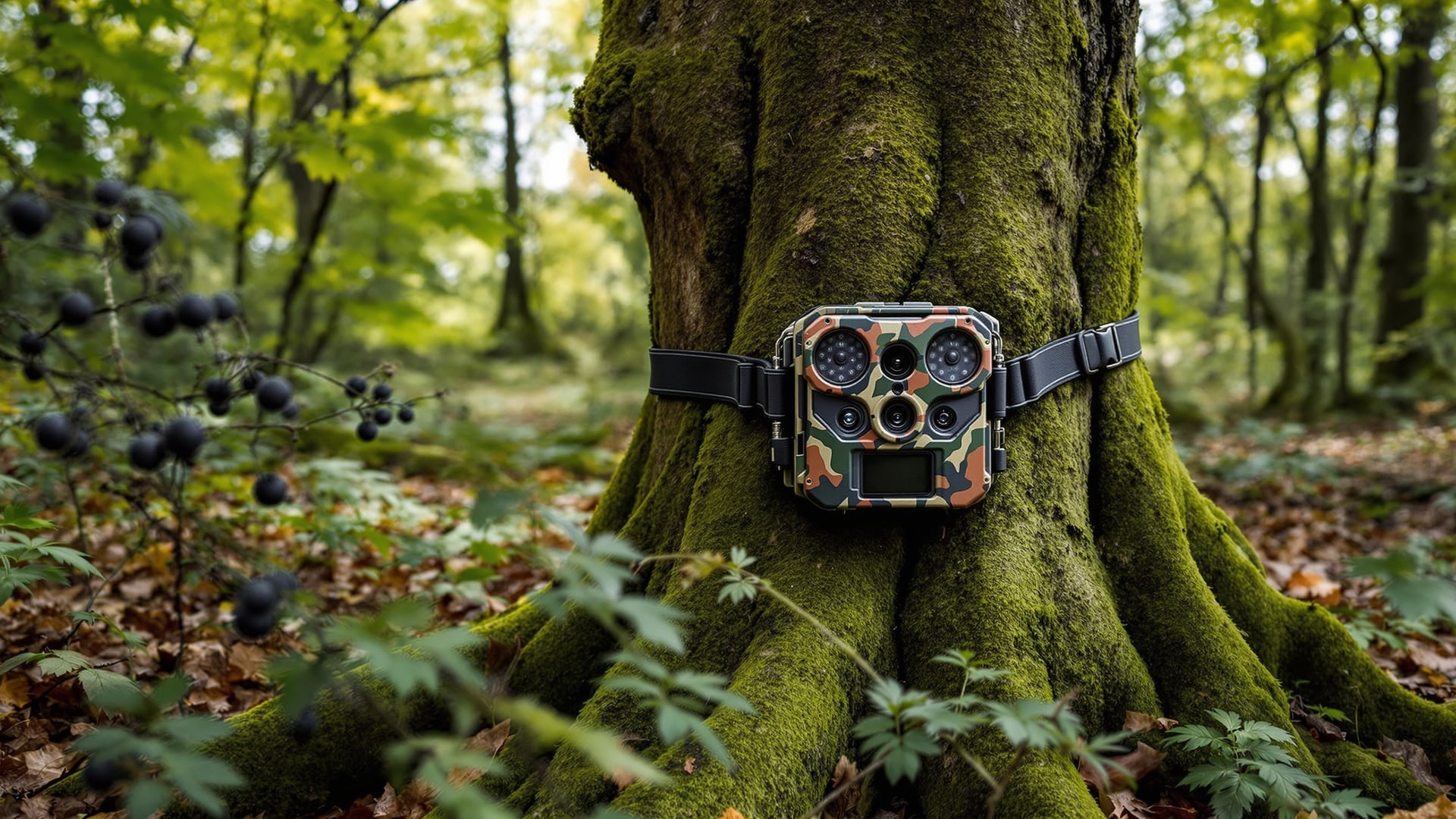
A trail camera — a camera trap — is three devices in one weatherproof case: a digital stills and video camera, a motion detector, and a recorder. It sits strapped to a tree or post, sees nothing for hours, and then wakes up, records, and goes back to sleep. This page answers the questions Handykam was asked most often about them.
How easy is a trail camera to set up and use?
Genuinely easy. Modern cameras have a small colour screen on the back and a simple button-and-menu system: set the date and time, choose stills or video, set the sensitivity and the delay between triggers, and close the case. Like any gadget there is a short learning curve — a bit of experimentation on a garden path before committing it to a hedge line will save you a fortnight of empty cards — but nothing about it requires technical knowledge.
Does a trail camera come with a memory card?
Usually not. Cards were normally bought separately, and the card is worth more thought than it sounds: a slow card can hold up the camera between triggers, and a card that is too small fills up and stops recording halfway through a fortnight in the field.
How does the detection actually work?
The motion sensor is a passive infra-red (PIR) detector. It does not send anything out; it watches for a moving source of heat crossing its field of view against a cooler background. That single fact explains almost every trail camera behaviour that puzzles people:
- A warm animal against cold ground triggers reliably. The same animal on a hot afternoon, when the ground is as warm as it is, may not.
- Something moving across the sensor's view triggers far more readily than something walking straight towards the camera.
- Sun-warmed vegetation moving in the wind triggers it. This is where most blank images come from, and why clearing the grass in front of the camera is the single best thing you can do.
What can it film?
Anything from small animals upwards. The rule is proportional: the smaller the subject, the closer the camera has to be, because what the sensor is really detecting is the area of warm moving surface. A badger at fifteen metres is easy; a wood mouse at fifteen metres is invisible. If you want small mammals, get the camera down to a metre or two and angle it at a specific point — a log, a feeding station, a gap in a hedge bank.
Where can you put one?
Almost anywhere. Cameras come with a strap and buckle and go round a tree, a post or a gate in seconds. Brackets that allowed proper swivel and tilt were a worthwhile addition, because a camera strapped to a curved trunk points wherever the trunk points, which is rarely where the animals are. Height matters: roughly knee to waist height covers most British mammals, and higher angles tend to produce pictures of backs.
Does the flash give the camera away?
No. When it is dark the camera switches on invisible infra-red illumination rather than a white flash. There is no visible burst, so the subject is not startled and the camera's position is not advertised. Some cameras use a low-glow infra-red that shows a faint red shimmer at very close range; true no-glow units show nothing at all.
Can I see the pictures on the camera itself?
Yes. The colour screen on the back shows a live view for aiming as well as playback of the stills and video already recorded, so you can check a camera in the field without carrying a laptop into a wood.
Why are some cameras so much cheaper than others?
Sometimes because the brand is newer and less established rather than because the technology is worse — the sensor and lens modules in this market are widely shared, and a lesser-known name can be genuinely comparable. Sometimes, though, the saving is real and lives in the places that matter: trigger speed, sensor range, battery life and the honesty of the quoted resolution. What separates the two is set out in Choosing the best trail camera.
Using one responsibly
A trail camera pointed at a garden or a footpath can capture people as well as wildlife, which brings it inside data protection law — the Information Commissioner's guidance is the reference for anything recording beyond your own boundary. And a camera pointed at a den, sett or nest is capable of causing disturbance: badger setts have their own protection, and Natural England's licensing guidance covers birds. For finding out what is actually using your garden in the first place, Hedgehog Street and the People's Trust for Endangered Species both run recording schemes worth contributing to.
Related pages: FAQ: trail cameras · Choosing the best trail camera · Camera resolution